Friday, 9 November 2012

Creature Feature: Purple Sun Star


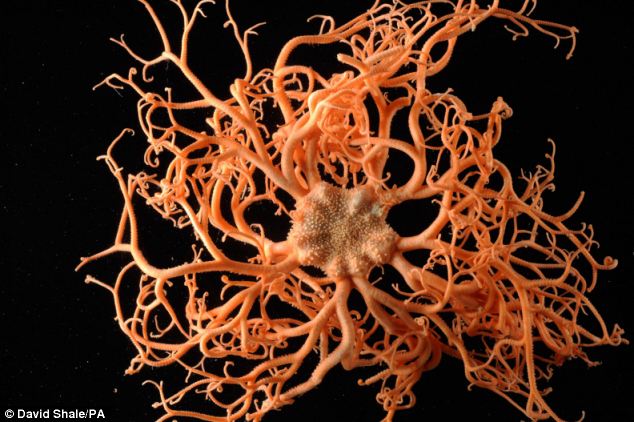
The Purple Sun star (Solaster endeca), also known as the Northern Sun Star or Smooth Sun Star is one of the few sea stars to have more than 5 legs. It may have anywhere from 7 to 14 arms, which gives it its ‘sun’ like appearance.  The colour of this sun star ranges from pale yellow to purple and even red although the purple colour seems to be most common in this area.  It is a larger sea star and may be up to 40 cm across.  It is found mainly in the subtidal zone and up to depths of 320 meters or more but very rarely, it may be found in the low intertidal area.  This species of sea star feeds mainly on sea cucumbers, other sea stars, molluscs and sea urchins.
 
 
A Purple Sun Star under examination in the lab.

 
This one was pulled up in the scallop drag aboard the Fundy Spray.


Two vastly different-sized sun stars.

Wednesday, 7 November 2012

Creature Feature: Northern Rock Barnacle


The Northern Rock Barnacle (Semibalanus balanoides) also known as the common rock barnacle is found fastened to rocks in the low intertidal zone to the shallower waters of the subtidal area.  This is the most commonly found barnacle in this area and can be identified by its rough grayish white shell.  It does not have a calcareous base as some other barnacles do. 
The barnacle is an arthropod and a crustacean, meaning it is related to crabs and lobsters.  It does not have a hard exoskeleton so must build a shell around itself for protection. It is the only crustacean that is stationary for its entire life.  Once the barnacle is finished with its planktonic larval stage, it will glue itself head down onto a rock substrate where it will create the shell around itself. It will not move from this spot for its entire life cycle.
Rock barnacles are hermaphroditic (both male and female).  They reproduce sexually but do not release their eggs and sperm into the open water; rather their fertilization is internal wherein one barnacle acts as the male and will reach to another barnacle that will act as the female and accept the sperm and brood the eggs within their shell. Once the eggs are hatched they will be released into the water.  A single adult barnacle may release up to 10,000 larvae into the water.  When these larvae settle, they may chose something other than rocks to attach to, such as the hulls of boats, lobsterpots and even slow moving or fairly stationary creatures such as Horse mussels.  The cement they secrete to attach themselves to things is very strong and currently being studied for possible use in dental applications.
 
Diagram of the internal anatomy of the Rock barnacle; though note the Northern Rock Barnacle does not have a calcerous disk on the bottom.

 
Colony of rock barnacles. Note the gastropod; Dogwinkles are known to feed quite frequently on barnacles.


Monday, 5 November 2012

Creature Feature - Northern Horsemussel

The Northern Horse mussel (Modiolus modiolus) is found subtidally, sometimes buried in gravel or rocks. It uses byssal threads to attach itself to various substrates like it smaller cousin the Blue Mussel. It is larger than the commercially grown Blue mussel and can grow up to 15cm long and live anywhere from 20 to 100 years. The Horse Mussel is a suspension feeder, which is similar to filter feeding but instead of actively drawing water into itself, the Horse mussel feeds on whatever happens to flow through. The Horse mussel is preyed upon by lobsters, crabs, sea ducks and some marine mammals. These bivalves are edible but are not as popular as the smaller Blue mussel.


The Horse Mussel.


 In its natural habitat.


Inside of the Horse Mussel; note the byssal threads in the middle, the gill beside and the mantle below.
 

Thursday, 1 November 2012

Creature Feature - Waved Whelk

Today's featured animal is the Waved Whelk (Buccinum undatum). The Waved whelk is of the phylum mollusca and class gastropoda. This particular whelk makes its home on rocky or gravel substrates with the young living in tide pools, while the older Waved whelks prefer deep water. The shell of the Waved whelk is unique in that is has both axial and spiral ridges, giving it the easily identifiable 'waved' appearance. These whelks are mainly carnivorous and feed on polychaete worms and bivalves. The Waved whelk can force the shell of a bivalve open by using the edge of its own shell or it may also bore a hole into the shell and suck out the inside. The Waved whelk is also known as a scavenger, and will eat dead fish or bait from lobster traps that it can detect from a considerable distance using olfaction. The siphon that is used to direct water over its gills also acts as a sensory organ. The Waved whelk is preyed upon by sea starts, and in Europe is commercially fished. This whelk can live up to 10 years and reach a size of 14cm high.

 
The Waved Whelk; note the siphon protruding from the front.

 
A diagram of the Waved Whelk.

Wednesday, 31 October 2012

Happy Halloween!

Happy Halloween from the Huntsman Marine Science Centre. We hope that everyone stays safe tonight and that the weather left over from Hurricane Sandy lets up in order to enjoy some fun Halloween activities.
In the ocean there are many places that are still being explored or have not yet been explored. Scientists are discovering new weird and wonderful things all the time.  Here are some new somewhat spooky discoveries that have been made in the depths of the ocean, in only the last decade!