This article was published a few years ago in our newsletter, SeaWords. I thought it would be fun to share again.
Beyond Classroom Walls
With 160 billion tonnes of water flowing in and out of the Bay of Fundy with each tidal cycle – more than the combined flow of the
world’s rivers – it is easy to see why its one of the seven natural wonders of Canada. For over 30 years the Huntsman Education
Department has introduced 42,000+ students to the wonderful classroom that is the Bay of Fundy.
Ten Reasons the Bay of Fundy is a Great Classroom
1. Live specimens – Being able to touch and closely observe live marine creatures is an amazing opportunity that engages and
excites students.
2. Real time data – Students are able to gather data on invasive species, marine mammals, fish, invertebrates, zonation patterns,
and temperature and salinity gradients.
3. Cross curricular – Marine biology is the main focus however, math, art, history and language arts are all by-products as
students analyze statistics, complete biological drawings, learn about the area and fishing history and pick up new vocabulary.
4. Biodiversity –As one of the most biologically rich and productive environments on our planet, the Bay offers encounters with
invertebrates, fish, seabirds, marine mammals, seaweeds, plankton and more. One group of students identified over 30 species
of invertebrates they had collected from the benthic and intertidal environments!
5. Engages all senses – While out on our research vessel, students use all their senses, even taste. Sample a scallop you just
caught, smell the salt air, touch a slippery sea cucumber, listen to the gulls and see the beautiful ocean around you.
6. Highest tides in the world – These amazing tides, that drop eight meters, in six hours allow students to walk on the ocean
floor and get a firsthand view of an ‘underwater habitat’.
7. Encourages teachable moments – Being in the field allows teachers to take advantage of ideas that capture a student’s interest,
without the constraints of bells and class schedules.
8. Flexible – Engages students of all learning styles and encourages curiosity.
9. Unplugged – Why would you want to be plugged in when you could be on the search for a four foot worm on the mud flats?
10. It’s Canada – What better place to explore and understand but those habitats which are your own backyard.
And last, but not least, its fun!
To make the Bay of Fundy your classroom book a field trip. Visit our website for more details.
Tuesday, 5 January 2016


Wednesday, 18 November 2015
SeaWords - Fall 2015

- The Bay is it a changing - notes from the 2015 field season
- Whale sightings - 2015
- NEW - The Marine Debris Program
- Activity: The Great Diatom Race
- Sea Creature Facts: Phytoplankton
- Dates for our summer field courses
Tuesday, 17 November 2015
Hands-on Learning
The Huntsman Marine Science Centre Education Department offers lots of exciting, hands-on learning opportunities for people of all ages. Here is a comprehensive list (click on the links for more information):
- Ocean Exploration for Homeschoolers
- Introduction to Marine Biology - for 5-18 year olds
- All Things Marine - NEW program for FAMILIES
- Young Explorer Days - day camps for 7-12 year olds
- Young Explorer Week - week-long camp for age 7-12
- University Field Courses - the summer of 2016
- University Marine Semester - the fall of 2016
- Road Scholars - for adults
To register or ask questions about our programs send us a note or call (506) 529-1200.
Friday, 23 October 2015
Leo Hayes High
For the past few days we have had students from Leo Hayes High on campus. While here the students have learned about the marine habitat while aboard our research vessel, the Fundy Spray, studied plankton in the lab, toured the Huntsman Fundy Discovery Aquarium, completed a lab about microbeads found in toothpaste and facial scrubs, cleaned up our beach (thank you!!), gathered data on an invasive species, and job shadowed with the Huntsman Aquaculture Department. Here are some pictures of their experiences on campus.


Microbead lab.

All of the blue spots are microbeads (plastic) that were in the toothpaste. Yuk!

Cleaning up the Huntsman beach.

#DebrisFreeFundy

Searching for the invasive green crab.

Crabs are measured and then given a mark of nail polish.

Cool! The students found a crab that was regenerating one of its claws.

Job shadowing and learning about salmon aquaculture.

Working with the urchin study.
Wednesday, 21 October 2015
Grade 6 Ocean Discovery - SJDA
Today I had the pleasure of working with the grade 6 students from Sir James Dunn Academy as part of the Ocean Discovery Program. Here are some pictures from their day at the Huntsman.



Studying plankton using the microscopes.

Observing and identifying invertebrates in the lab.

Lunch and touch tank time.

The students explored the intertidal zone and found...

rock gunnel fish...

sideswimmers and...

green crabs.

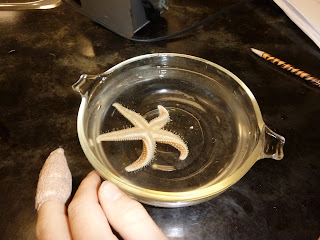
Completing a behaviour experiment with sea stars.
Thank you to Living Environmental Studies Foundation for partnering with the Huntsman to provide the Ocean Discovery program to Grade 6 students in the Anglophone School District - South.
Subscribe to:
Posts (Atom)